The NeurIPS 2023 Ethic Review process began with the publication of the Code of Ethics. This step formally codified a foundation for ethics within the conference framework.
This year, 502 papers (3.77% of all submissions) were flagged for ethics review. This represents an increase in the number of papers flagged last year (474) but a decrease in the overall rate of papers being flagged (from 4.37% in 2022).
In particular, we are heartened that fewer submissions in the Datasets and Benchmarks track were flagged for ethics review, despite the number of submissions more than doubling since last year. We believe that these trends mean that the ethics of ML research is being taken more seriously by the research community.
2023
2022
Paper statistics (preliminary)
Main track
D&B track
Total
Main track
D&B track
Total
Papers submitted
12,345
976
13,321
10,411
447
10,858
Total papers flagged for ethics review
395
107
502
362
112
474
Flag rate
3.20%
10.96%
3.77%
3.48%
25.06%
4.37%
This year, reviewers in the main track were required to flag at least one specific area for ethics review. Note that papers can be flagged for multiple areas, so the percentages below do not add up to 100%.
Notably, discrimination, bias and fairness concerns have been flagged at nearly triple the rate this year compared to last year; the rate of papers flagged for legal compliance or responsible research practice also doubled.
Papers flagged by area (main track only)
2023
2022
Discrimination / bias / fairness concerns
122
33.7%
47
13.0%
Privacy and security
91
25.1%
63
17.4%
Legal compliance
39
10.8%
17
4.7%
Inadequate data and algorithm evaluation
83
22.9%
35
9.7%
Responsible research practice
61
16.9%
30
8.3%
Inappropriate potential applications and Impact
76
21.0%
47
13.0%
Research integrity issues
63
17.4%
56
15.5%
Failure to comply with NeurIPS Code of Ethics
53
14.6%
New in 2023
I don’t know
Deprecated
38
10.5%
No area flagged
Deprecated
80
22.1%
Total
395
362
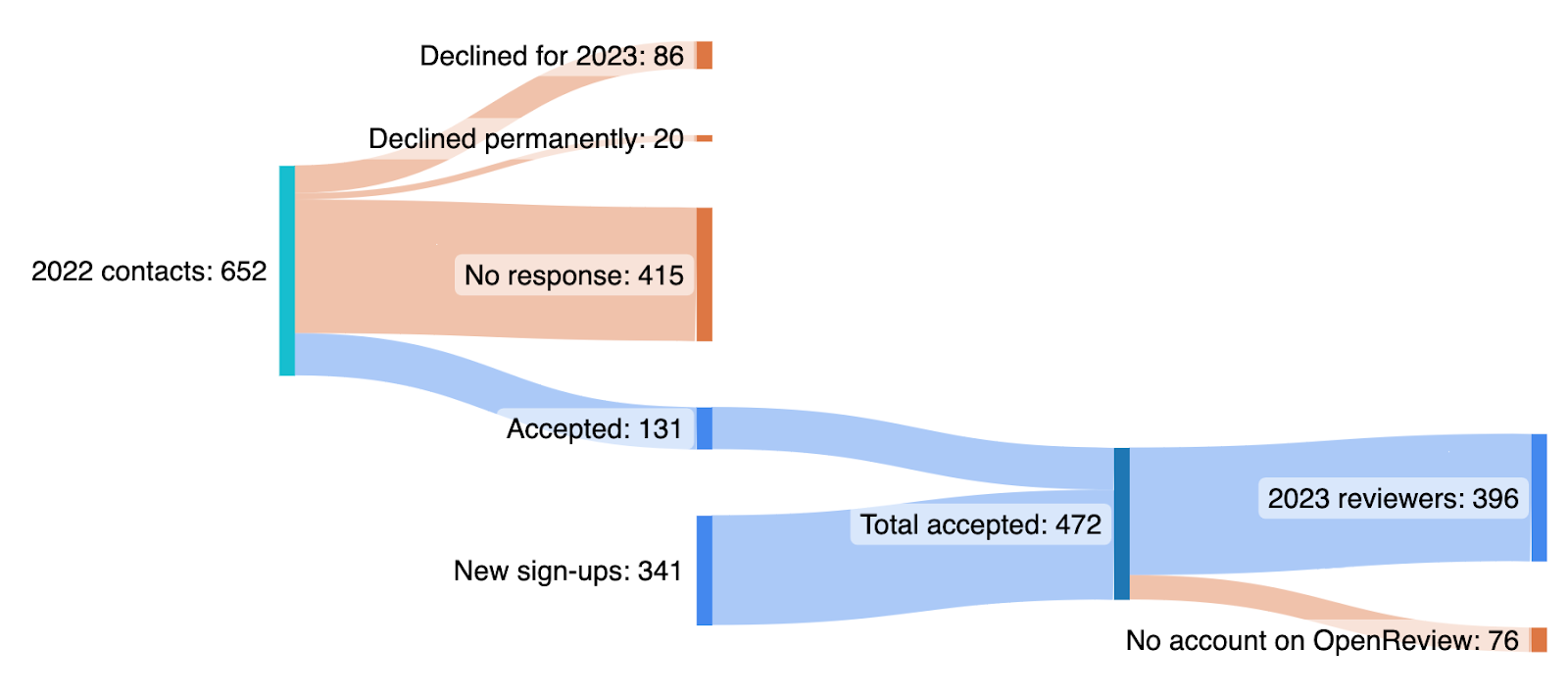
This year, we invited everyone contacted for ethics reviews from last year to serve again as ethics reviewers, and also issued an open call for new reviewers. A total of 396 ethics reviewers answered the call.
In addition, we also asked reviewers if they were available as emergency ethics reviewers, to provide missing reviews and reviews for papers flagged for review on short notice. 76 people volunteered as emergency ethics reviewers.
We are immensely grateful to everyone who answered the call to service, which allowed us to handle the increased workload for ethics reviews, while broadening the community and reducing the average number of reviews per reviewer.
Thank you all for a wonderful and successful ethical review process.
by Saadia Gabriel, Andrew Gordon Wilson, Marzyeh Ghassemi
We are excited to announce the tutorials selected for presentation at the NeurIPS 2023 conference! We look forward to an engaging program, spanning many exciting topics, including human-AI collaboration, diffusion models, automated theorem proving, efficient deployment of large language models, AI governance for accountability, and others. In this blog post, we detail the upcoming program and our selection process.
Tutorial Program
There will be 14 tutorials this year. To encourage active participation and facilitate community-building, we restricted tutorials to an in-person format. Another important feature of this year’s tutorials is the inclusion of a panel discussion. These panels open up the conversation to allow for diverse perspectives on the tutorial topic and lively exchange of ideas. The 2023 tutorials are:
Machine Learning for Theorem Proving Speakers: Emily First, Albert Q. Jiang, Kaiyu Yang
Governance & Accountability for ML: Existing Tools, Ongoing Efforts, & Future Directions Speakers: Emily Black, Hoda Heidari, Dan Ho
Application Development using Large Language Models Speakers: Andrew Ng, Isa Fulford
Data-Centric AI for reliable and responsible AI: from theory to practice Speakers: Mihaela van der Schaar, Isabelle Guyon, Nabeel Seedat
Do You Prefer Learning with Preferences? Speakers: Aditya Gopalan, Aadirupa Saha
How to Work With Real Humans in Human-AI Systems Speakers: Elizabeth Bondi-Kelly, Krishnamurthy (Dj) Dvijotham, Matthew E. Taylor
Language Models Meet World Models Speakers: Zhiting Hu, Tianmin Shu
Exploring and Exploiting Data Heterogeneity for Prediction and Decision-Making Speakers: Peng Cui, Hongseok Namkoong, Jiashuo Liu, Tiffany Cai
Recent and Upcoming Developments in Randomized Numerical Linear Algebra for ML Speakers: Michał Dereziński, Michael Mahoney
Reconsidering Overfitting in the Age of Overparameterized Models Speakers: Spencer Frei, Vidya Muthukumar, Fanny Yang
Contributing to an Efficient and Democratized Large Model Era Speakers: James Demmel, Yang You
Latent Diffusion Models: Is the Generative AI Revolution Happening in Latent Space? Speakers: Karsten Kreis, Ruiqi Gao, Arash Vahdat
What can we do about NeurIPS Reviewer #2? Challenges, Solutions, Experiments and Open Problems in Peer Review Speaker: Nihar Shah
Data Contribution Estimation for Machine Learning Speakers: Stephanie Schoch, Ruoxi Jia, Yangfeng Ji
Selection Process
We received 54 proposal submissions this year. Each submission was reviewed by the Tutorial chairs, with the chair reviewing assignments based on expertise and avoiding conflicts of interest. Each chair gave a score between 1 (strong reject) to 10 (strong accept) to encapsulate their overall impression of the proposal. We then shortlisted the submissions that had received an average score of 5 or higher and discussed when there were disagreements between the initial reviews. A third review was then obtained from a different Tutorial Chair to finalize the decision to accept or reject a proposal. We accepted 14 proposals with this process.
Some relatively common reasons for low scores included (but were not limited to):
The topic was too niche for a very broad audience.
There were stronger submissions covering the same topic.
Tutorial was not focused enough on core skills, or was formulated more as a workshop or talk.
The tutorial was too focused on the work of a particular speaker or panelist.
Low diversity, especially gender diversity.
Guidelines were not followed (e.g. no panel included).
In the call for proposals, we emphasized the need for diversity in the teaching teams and panels. This was met with an overwhelming positive response. We look forward to tutorials that are representative of many NeurIPS community members.
Stay tuned for a post-conference retrospective blog post with reflections on the tutorials and thoughts for next year. You can share your tutorial experiences for a potential feature in the blog here.
Welcome to the September edition of the monthly NeurIPS Newsletter! This newsletter was sent out by email to all subscribers on September 20, 2023, but we reposting on our blog as a monthly digest. To receive this newsletter in your email inbox directly, subscribe at: https://neurips.cc/Profile/subscribe. For more information on email preferences, visit: https://neurips.cc/FAQ/EmailPreferences
The NeurIPS Newsletter aims to provide an easy way to keep up to date with NeurIPS events and planning progress, respond to requests for feedback and participation, and find information about new initiatives. Notably, this newsletter will focus on NeurIPS 2023, which will return to New Orleans from Sunday, December 10th – Saturday, December 16th, 2023.
This year NeurIPS opened registration April 11th to provide early access to visa materials (https://neurips.cc/Conferences/2023/Visa) in section five of the registration process. The Cancellation Policy (https://neurips.cc/FAQ/CancellationPolicy) contains considerations for visa denials, and the conference will grant a full refund before November 14th, 2023.
NeurIPS recognizes that this step may not solve all visa-related issues, but we hope it makes the process smoother for a significant number of attendees.
2. Upcoming Calls for Participation
NeurIPS is welcoming a second round of proposals for socials, due October 18th 2023 AoE (Anywhere on Earth). Socials are events focused on the social aspects of the conference, rather than the technical ones, creating space to meet up, discuss, or celebrate around a common interest. For more information on how to submit a proposal, read: https://neurips.cc/Conferences/2023/CallforSocials
NeurIPS is soliciting applications for the EXPO from Diamond & Platinum exhibitors. The NeurIPS EXPO is a one day (Sunday December 10th 2023), multitrack, interdisciplinary section of the conference focused on ideas being developed in an industrial context. Deadline for expos is October 13th 2023 AoE. For more details, read: https://neurips.cc/Expo/CallForTalksPanels
3. Event Week – Schedule at a Glance
Curious how the conference week will look? See the daily events:
Sunday December 10th
NeurIPS Expo
Monday December 11th
Affinity Workshops
Tutorials
Opening Remarks, First Keynote, and Reception
Tuesday December 12th and Wednesday December 13th
Main Conference: Keynotes, Posters, and Oral Sessions
Socials (Evening)
Thursday December 14th
Main Conference: Keynotes, Posters, and Oral Sessions
Townhall
Closing Reception
Friday December 15th
Workshops
Socials (Evening)
Saturday December 16th
Workshops
4. Program and Datasets & Benchmarks Updates
Reviews are underway and nearing an end! Poster, Oral and Spotlight decisions will be announced for both the Main Program and Datasets & Benchmarks tracks September 21st at 9:00 PM EDT. Reviewing at scale presents many challenges. This year, we received 13,330 submissions, coordinated over 13,500 reviewers, 1,100 Area Chairs, and 100 Senior Area Chairs across both tracks. On behalf of the Program Chairs and Datasets & Benchmarks Chairs we thank our reviewers, ACs, and SACs for making this possible.
5. Affinity Workshops
At NeurIPS, affinity groups play a crucial role in advocating for and amplifying the ideas and voices of marginalized communities. This year, we’re excited to host eight Affinity Workshops on Monday. Many Affinity Workshops have released calls for contributions, and they welcome your work:
Tutorials are self-contained events covering emerging ML & AI topics, led by a small number of speakers with panels to broaden discussion. This year, we’re excited to announce a total of 14 tutorials – stay tuned for an upcoming blog post next month with the full list of accepted tutorials.
7. Workshops
NeurIPS Workshops provide a structured means of bringing together attendees with shared interests to form communities. This year, we’re excited to host 58 workshops that will take place on December 15th & 16th. Many of these workshops will have a submission deadline near September 29th, 2023 AoE (Anywhere on Earth), so mark your calendar!
NeurIPS Competitions promote innovative research and foster collaboration across different scientific disciplines by providing an opportunity to showcase research and compete with other leading researchers. We’re excited to host 20 competitions in this year’s Competition Track on Friday Dec 15th and Saturday Dec 16th 2023.
This year saw 502 papers (3.77% of all submissions) flagged for ethics review, up in absolute number from last year (474), but down in relative terms (4.37%). We thank our 396 ethics reviewers and especially the 76 who also volunteered as emergency reviewers. Please watch for our detailed report on the ethics review process, coming soon!
10. Outreach
At NeurIPS, we’re always looking for ways to grow our community, with focus on demographics underrepresented in ML/AI. This year in NeurIPS Outreach, we are planning to invite undergraduate and graduate students from local colleges and universities including HBCUs. Stay tuned to hear more about the details in the coming newsletters!
11. Call to Register for Childcare
NeurIPS is proud to be providing free on-site child care at the conference this year. Registration deadline for child care is November 30th 2023, and is on a first-come first-serve basis. For more information on how to register, please read: https://neurips.cc/Conferences/2023/ChildCare
12. Support to Attend NeurIPS
Applications for financial assistance and volunteering will be open soon after the conference paper decision notification date. We are aiming for a rapid turnaround, especially on applications from authors of accepted conference papers, to give attendees sufficient time to organize travel. Keep an eye on the conference homepage for further updates this month!
Thanks and looking forward to seeing you at the conference,
Summary: NeurIPS is hosting a college outreach program in New Orleans on Monday, Dec. 11th. Our vision is to empower students to engage with AI and learn how it can impact their lives.
Hello! We’re Jihun and Ed, the outreach co-chairs for NeurIPS 2023. We’d like to introduce our plan for the college outreach program at this year’s conference!
Last year, we piloted a high school outreach program, attracting widespread interest with over 240 students from 12 high schools in New Orleans attending NeurIPS. The scale of engagement and impact from this program reaffirms how important it is to give junior researchers an opportunity to participate in machine learning and artificial intelligence.
This year, to ensure that we are giving opportunities to students at various stages of education, we are focusing our outreach opportunities on college students, who will be given unrestricted access to the full NeurIPS program, allowing them to choose sessions based upon their own preferences and pacing.
We are working with local colleges in Louisiana and NOLA in particular, with a focus on HBCU students and with a goal of contributing back to the local community. With the partnership of these local institutions, we’re organizing an outreach event on Dec. 11th to introduce students to NeurIPS and the world of AI. Students participating in our outreach program will get to participate in a special outreach session with a keynote and lunch, receive recommendations for sessions, and be given full access to the entire conference!
Our Vision
NeurIPS plans to invite students from local colleges to visit the conference. Since we understand navigating a giant conference for the first time can be overwhelming, our aim is to provide special sessions and some schedule recommendations for students, while still giving them flexibility and freedom to dictate what main conference sessions they prefer. Students will benefit from:
An outreach session with a keynote and lunch to get introduced to NeurIPS
Invitations to affinity workshops and the dinner reception to socialize with the community
Access to tutorials and the main conference program to engage with AI experts from around the world
Throughout our planning process, we will be partnering with members of the New Orleans community. We recognize that we don’t have all the answers. Our job as co-chairs is to create a program that benefits students first – and that involves bringing educators, community leaders, and students to the table.
What’s Happening Next
As co-chairs, we’re currently working on two responsibilities
Gathering feedback from the New Orleans community and iterating on event specifics
Working with our logistics partners on food and transportation.
Expect another update from us with more specifics soon.
We’re excited to run this iteration of NeurIPS outreach. If you have any suggestions, questions, or feedback, please let us know!
Jihun Hamm, Edward Choi
Outreach Chairs, NeurIPS 2023
Email: outreach-chairs@neurips.cc
Appendix: more about us!
Jihun here! I’m an associate professor at Tulane University located in the heart of New Orleans, one of the most unique cultural and historical cities in the US. My main research interests are robust ML, optimization and medical applications of ML. I have taught ML and Deep Learning classes in and outside of computer science. I am glad to have the opportunity to invite Louisiana college students to the outreach program in my hometown NOLA.
Ed here! I’m an assistant professor at KAIST, South Korea. My main research area is AI for healthcare, specifically interested in machines that can understand medical data. I have been teaching an AI programming course for several years, where I had the pleasure to engage with the newcomers of the AI and help them acquire the programming skill to build their own AI models. I’m excited to serve as an outreach chair this year to interact with students of Louisiana!
This year’s outreach program would not have been possible without helpful input from Matt Wang and Jessica Forde, who were last year’s outreach chairs!
by Arjun Subramonian, Konstantina Palla, Ogbuokiri Blessing
We are excited to announce this year’s affinity workshops co-located with NeurIPS.
What are affinity groups?
At NeurIPS, affinity groups play a crucial role in advocating for and amplifying the ideas and voices of marginalized communities, bringing attention to the various issues that affect their members. In addition, they provide members of these affinity groups with increased opportunities to showcase their work, engage in discussions, and build connections during NeurIPS events, promoting diversity and inclusion at NeurIPS
The primary goal of workshops is to encourage individuals marginalized in the machine learning community to present their research and become active contributors to the NeurIPS community. In contrast to regular workshops, affinity group workshops adopt a more open and flexible approach around topic area, focusing on forming research communities within the affinity groups and bringing attention to the unique challenges faced by their members.
Additionally, affinity group socials serve as safe and welcoming spaces, allowing members to interact, socialize, and network in an inclusive environment. By fostering such social gatherings, NeurIPS supports the creation of a supportive community that values diversity and ensures that all voices are heard and valued.
What kind of events do affinity groups offer at conferences?
Affinity groups organize workshops and social events for their members at conferences, for which the D&I committee provides support. The main aim of the workshops is to encourage people to showcase their work and step into the NeurIPS community. Most affinity events at NeurIPS this year will take place on Monday, December 11 in-person. NeurIPS will offer streaming support for all the in-person components of the affinity groups. However, individual groups also have the option to organize additional virtual components if they wish to. The specific timings will be communicated by the affinity groups as the conference dates draw nearer.
What can NeurIPS attendees do to support affinity groups?
Participate! Actively attending and participating in panels and sessions for discussions about issues that are relevant to the affinity groups goes a long way in helping promote their cause. We request all members of our community to participate actively!
Black in AI workshop
Black in AI exists to create a space for sharing ideas, foster collaborations, and discuss initiatives to enhance the representation of Black individuals in the field of AI. NeurIPS, being one of the largest AI research conferences, offers a valuable opportunity for researchers in the community to stay updated on the latest research and expand their network. Since its inception in 2017, the Black in AI workshop has had a profound impact. Many members of Black in AI have walked away from their experience at NeurIPS with internship offers, graduate program advisors, mentorship, and renewed energy to continue working in the field. The workshop remains committed to bridging the gap between Black researchers and the AI community at large. For more information, please visit the Black in AI website.
Global South in AI workshop
The Global South in AI workshop is organizing an affinity session focused on Generative AI, with an emphasis on the languages and cultural history of the global south. The session aims to explore both the potential benefits and challenges of Generative AI in a creative and engaging manner. Participants are encouraged to showcase innovative use cases of Generative AI in global south countries using LLMs and to also address issues related to access difficulties or negative impacts arising from its use. For more information, please visit the Global South in AI website.
Queer in AI workshop
The Queer in AI workshop at NeurIPS 2023 aims to gather diverse perspectives from queer students, researchers, and practitioners worldwide to assess the impact of AI on the LGBTQIA* community. The workshop seeks to build a community of queer individuals, foster discussions at the intersection of AI and queer identities, and address the discrimination faced by the LGBTQ+ community in the tech sphere and beyond. The workshop highlights the need for a more ethics-driven approach in AI development and challenges the exclusion of critical voices in AI discussions. It also aims to create an inclusive space for young queer students in academia, where their identities are recognized and celebrated rather than marginalized. By using NeurIPS as a platform, the workshop intends to promote equitable AI and contribute to a future where technology benefits people of all identities and backgrounds. For more information, please visit the Queer in AI website.
LatinX in AI workshop
The LatinX in AI research workshop is a full-day event featuring invited speakers, oral presentations, and posters. It provides an excellent opportunity for faculty, graduate students, research scientists, and engineers to come together, fostering connections and idea exchange. The workshop includes a panel discussion and mentoring session to explore current research trends and career paths in artificial intelligence and machine learning, with a focus on the distinct challenges faced by LatinX identifying researchers. The main objective is to create a platform for showcasing the work of Latinx researchers, and we warmly invite everyone to join us at this event. For more information, please visit the LatinX in AI website.
Women in ML workshop
The goals and activities of WiML are to
Highlight the work of researchers in machine learning who are women or nonbinary,
Give them a chance to meet, encourage technical discussion, and future collaboration,
Give junior researchers an opportunity to present their work to their peers as well as senior members of the community.
The workshop plans to feature speakers who are women or nonbinary to give talks on their research, organize mentorship sessions to discuss relevant topics, and encourage networking. It will encourage and foster research conversations and help participants develop collaboration opportunities. There will also be poster sessions for participants to present a broader array of work and exchange feedback. For more information, please visit the Women in ML website.
North Africans in ML workshop
The North Africans in ML workshop aims to foster collaboration, networking, and skill development and create a supportive community that celebrates and amplifies the contributions of North Africans to the world of machine learning. We aim to create a sense of community among North African researchers in ML, increase the visibility of North Africans within the AI community, highlight their accomplishments, and acknowledge and discuss the hardships faced by researchers based in North Africa.
The workshop will feature various activities such as talks, panel discussions, poster sessions, and a social event. Distinguished experts in machine learning will present cutting-edge research and its applications in the North African context, offering valuable insights and inspiration. The panel discussions will specifically address challenges faced by North African communities in ML research. For more information, please visit the North Africans in ML website.
Muslims in ML workshop
The Muslims in ML workshop aims to explore the intersection of machine learning, fairness, and the global Muslim community. It recognizes the potential of AI and ML to bring positive changes but also acknowledges existing barriers and biases that may perpetuate unfairness against Muslims. The workshop aims to bring together diverse experts and perspectives to examine challenges and opportunities in integrating AI/ML in the lives of Muslims and those in Muslim-majority countries. It will showcase research by Muslim scholars in ML and highlight work addressing challenges faced by the Muslim community. The workshop provides a safe space for open discussions and social activities. It adopts an inclusive approach that considers cultural association and proximity to the Muslim identity, emphasizing the importance of understanding the complexity and diversity within the Muslim community. The workshop seeks to promote awareness, collaboration, and mitigation strategies to ensure fair and equitable implementation of AI/ML technologies for Muslims worldwide. For more information, please visit the Muslims in ML website
New in ML workshop
The New in ML workshop aims to welcome new researchers in the community and provide them with some guidance to contribute to Machine Learning research fully and effectively. In addition to catering to newcomers, the workshop recently extended its audience to include senior PhDs undergoing role changes, transitioning to academia or industry, thereby embarking on new paths within their ML career. The workshop plans to host presentations offering guidance on how to conduct research from experienced researchers and broadcast them to attract local and remote participants. Attendees will also have the opportunity to be mentored by senior researchers to refine their academic writing and oral presentation skills and boost their chances to have their papers published at the future top conferences. For more information, please visit the New in ML website.
by Hsuan-Tien Lin, Ismini Lourentzou, Piotr Koniusz and Yarin Gal
We are excited to announce the list of NeurIPS 2023 workshops! We received 167 total submissions — a significant increase from last year. From this great batch of submissions, we have accepted 58 workshops that will take place in-person on Dec. 15 & 16.
We wish we could have accepted many more workshops given the exceptional quality of submissions this year, but technical and logistical constraints meant we could only accept a limited subset. This marks another year that workshop selection had to be selective, and we expect that many of the excellent proposals that we could not accept will be revised, resubmitted, and presented at other ML conferences.
Of course, we want to thank everyone who put in the effort to propose workshops. As Workshop Chairs, all we can do is guide the authors through the submission process. The actual work of organizing the workshops is done by the organizers. Thank you!
New This Year: Fully In-Person Workshops and Proposal Template
In contrast to the previous year, there will not be a separate virtual workshop day. All workshops are anticipated to be conducted in person. Our Call for Post-Conference Workshops emphasizes that NeurIPS will exclusively host in-person workshops this year, accompanied by comprehensive technical support to livestream the workshops to an online audience. We believe that this decision will offer the best experience for both the attendees present in person and those participating online. To assist proposal authors in preparing their proposals and enable reviewers to efficiently evaluate the key aspects of a successful workshop program, we introduced a proposal template this year. The template is experimental and its use is entirely optional for the proposal authors (although we strongly recommended its use). We are pleased to note that over 80% of the proposals adhered to or closely resembled the template. This greatly facilitated the organization and evaluation process, benefiting both proposal authors and reviewers alike.
Refinements: Review Process
We continued to use OpenReview as our submission platform this year, consistent with other NeurIPS submission tracks, due to the success of OpenReview in matching reviewers to proposals. We strived to ensure that every workshop proposal author had an OpenReview profile before the review period started, to better manage conflict-of-interests through OpenReview. Additional details about the selection process are provided below. Except for providing a proposal template, we did not alter requirements for the proposal much this year. We kept the length of the main proposal limited to three pages and the organizer information limited to two pages, along with unlimited references. We let reviewers know that they need not read beyond those pages.
Another point of feedback incorporated was to further refine the reviewing recruitment process. Thus, we increased the reviewer pool, with a focus on including more experienced organizers from past NeurIPS workshops as reviewers. As a result, we sent out over 300 invitations and managed to recruit 127 reviewers. This resulted in at least three reviews per proposal for all 167 proposals. The completion rate for assigned reviews reached 97%, and every proposal received at least three quality reviews. We thank all the reviewers for their timely and professional efforts to provide quality reviews that greatly assisted our decision-making and facilitated an exciting and well-informed workshop program this year.
Selection Process
In making our selections, we asked the reviewers to closely follow our Guidance for Workshop Proposals, which was also shared with the proposal authors. Workshop proposals must be reviewed somewhat differently from academic papers, and we therefore asked the reviewers to consider both scientific merits and broader impacts in their assessments. We recognize that workshop reviews might be somewhat more subjective than academic paper reviews. Following the practice of past years’ review process, we have decided not to release the reviews directly to the proposal authors. However, like last year, we released a short meta-review alongside the decision for each proposal — explaining how the proposal was perceived by the reviewers with the goal of highlighting what could be improved.
Individual evaluations of proposals by reviewers were important for the decision process, but they were not the only considerations in the decision process. For example, we also strived for a good balance between research areas, and between applications and theory. As interest across research areas is not uniform, some areas were more competitive than others. For example, as anticipated, there were many strong proposals surrounding large language models this year. We also received many submissions on important current topics such as privacy, fairness, and causality, as well as the connection between machine learning and other fields. We attempted to balance topics so they would cover both mainstays and emerging topics.
It is also worth noting that we saw many of the pitfalls in proposals also seen in previous years. This included leaning too heavily on past success of existing workshop series, unconfirmed or irrelevant speakers, insufficient time for discussion, scoping too big and too broad, and lip service to diversity.
The next step is for you to contribute! Several workshops have begun soliciting submissions, many using our suggested submission date of September 29, 2023. We typically let each workshop advertise its own call for papers (if they plan to include workshop papers). We will communicate with the workshop organizers some additional deadlines to facilitate the successful planning of 58 exciting workshops. Stay tuned for more technical and contextual information coming soon!
Today, we introduce the competitions that have been accepted at NeurIPS 2023 Competition Track. It seemed especially challenging this year given the number of quality submissions and the limited number that could be accepted. We selected a total of 20 very strong proposals, covering a wide range of areas and subdisciplines. Some of the competitions are completely new, others are familiar to the NeurIPS community. The selected competitions are now official and ready for the community to participate in. Please check the NeurIPS website for full competition details.
This year will mark the seventh year of NeurIPS having a dedicated competition track. Whether this is the first time you’re heard about NeurIPS competitions or you’re a grandmaster, this year’s cohort has something to offer for a variety of backgrounds, skill levels, and domain knowledge. We hope you’ll take some time to look over this year’s exciting set of competitions, and encourage you to participate!
Competitions have a valuable place in research and in solving complex problems.
As a participant, you will benefit from being exposed to a vibrant community! Indeed, they’re great for connecting to like-minded researchers, excellent for learning and resume building, and allow you to use your skills to have a real-world impact on important and challenging problems. After the challenges are complete, we hope that you continue collaborating with your former competitors to advance solutions for these important problems.
We are also excited to share that, starting from this year, competition reports co-authored by both organizers and participants will be subject to new publication requirements. To improve scientific rigor, transparency, and reproducibility, accepted competitions in 2023 will be required to submit their post-competition analyses as papers to the 2024 NeurIPS D&B track (next year).
The NeurIPS 2023 program includes the following exciting competitions:
We are very grateful to the colleagues that helped us with reviewing and selecting the competition proposals for this year. We congratulate all the authors on their accepted proposals, and we thank everyone who submitted a proposal for their fantastic work.
By Arjun Subramonian, Konstantina Palla and Ogbuokiri Blessing
We are calling for affinity groups to host workshops and/or socials at NeurIPS 2023. NeurIPS 2023 will take place Sunday, December 10, 2023 through Saturday, December 16, 2023. It will be a livestreamed and recorded conference and will be held in New Orleans at the New Orleans Ernest N. Morial Convention Center.
Goal of Affinity Workshops
The main aim of workshops is to encourage people to showcase their work and step into the NeurIPS community. Unlike other workshops, affinity group workshops are centered around creating space for communities marginalized in AI and ML, and generally accept a wider scope of submissions topic-wise. The idea of having affinity group workshops is to establish research communities out of affinity groups and raise awareness of the challenges faced by them. Furthermore, affinity group socials provide safe, inclusive spaces for members of affinity groups to socialize and network.
Previously, affinity groups like Women in Machine Learning (WiML), Queer in AI (QinAI), Black in AI (BAI), LatinX in AI (LXAI), {Dis}Ability in AI, Indigenous in AI, Global South in AI, Muslims in ML, and Jews in ML have organized workshops and socials at NeurIPS. In this call, we welcome applications from all kinds of affinity groups.
Affinity workshops will take place Monday, December 11, 2023, which will overlap with tutorials. By default, affinity workshops will be livestreamed and have Zoom access (unless the organizers wish otherwise). While we encourage workshops to have in-person components, we recognize that this is often difficult or impossible; as such, workshops can be entirely virtual.
Workshops may include but are not limited to one or more of the following: Keynote talks, Lightning talks, Panels, Poster presentations, Discussions and Art exhibits.
We will hold a separate in-person and virtual poster session exclusively for affinity groups on Monday, December 11, 2023. Authors from all affinity groups that issue a call for papers/contributions/media are required to participate in either the in-person or virtual joint poster session.
Every group considering submitting a workshop must read the Affinity Workshops and Socials Call NeurIPS 2023,which describes the philosophy behind hosting workshops, affinity group socials, joint poster sessions, selection criteria and process, format for proposals, and other frequently asked questions.
Submission instructions
You can send the proposal to the Affinity Workshops team (affinity-workshop-chairs@neurips.cc) in the form of a PDF file. Important dates for workshop submissions:
Workshop Application Open – May 10, 2023
Workshop Application Deadline – June 10, 2023 AOE
Workshop Acceptance Notification – June 17, 2023 AOE
By Samy Bengio, Sasha Luccioni, Inioluwa Deborah Raji, chairs of the Code of Ethics committee
The increasing real-world impact of ML research and applications increases both the likelihood of meaningful social benefit as well as the attendant risk of harm. This harm can often be minimized by practical improvements to research practice – including improved transparency, better documentation and the more purposeful dissemination of ML models and datasets.
This week, NeurIPS adopted a Code of Ethics to help guide our community towards higher standards of ethical conduct, including research ethics and the broader societal and environmental impacts of our work. The code is the result of a multi-year effort to establish guidelines and norms for submissions to NeurIPS. As such, it outlines conference expectations about the ethical practices that must be adopted by submitting authors, members of the program, and organizing committees.
The Code of Ethics complements the NeurIPS Code of Conduct, which focuses on professional conduct and research integrity issues, including plagiarism, fraud and reproducibility concerns. It also informs the NeurIPS Paper Checklist and Code and Data Submission Guidelines, which outline more concrete communication requirements around ML artifacts submitted to NeurIPS.
The Code of Ethics as it exists today is an initial version that will evolve over time, as new approaches and applications of ML are developed. We will continue gathering feedback from the community and will use it to update the code over the coming years, to better reflect the norms and values of the NeurIPS community.
Thank you to those who contributed towards the code of ethics: Alina Beygelzimer, Corinna Cortes, Kate Crawford, Thomas G. Dietterich, Barbara Engelhardt, Jeanne Fromer, Iason Gabriel, William Isaac, Amanda Levendowski, Jason Millar, Shakir Mohamed, Nyalleng Moorosi, Alice Oh, Marc’Aurelio Ranzato